

Potential consequences of a closure of the Strait of Hormuz
The Strait of Hormuz is one of the world’s most critical maritime chokepoints. Large quantities of raw materials are transported from the Middle East to international markets via this strait. Geopolitical tensions and damage to industrial infrastructure in the region have created uncertainty regarding the continuity of this transport route. The Netherlands Materials Observatory (NMO) has analysed the potential consequences for the availability of critical raw materials for the Netherlands in case of a (temporary or prolonged) closure of the Strait of Hormuz.
Countries around the Persian Gulf (including Qatar, Saudi Arabia, the United Arab Emirates, Iran and Bahrain) produce a significant amount of various raw materials. In addition to oil and gas, these include helium, sulphur, feldspar, gypsum, aluminium and bentonite. When assessing the consequences, the issues surrounding gas and oil have been excluded from consideration. The regional share of helium is particularly large: approximately one-third of global production takes place in the Middle East, with Qatar as the dominant region (see figure below).
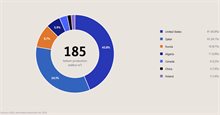
In particular, closure of the Strait of Hormuz affects maritime transport of bulk commodities. For these goods, alternative overland routes are generally not a viable option. Although a large proportion of exports from the region are destined for Asia and Africa rather than Europe, disruptions to transport and production could have global repercussions on availability and prices.
Damage to industrial infrastructure
In addition to logistical constraints, industrial complexes in the region have also incurred sustained damage. In particular, the Ras Laffan industrial complex in Qatar, a major production site for liquefied natural gas and helium, has been affected. The repair of damaged facilities is expected to take several years, leading to a structural reduction in available helium production.
Aluminium smelters in the region are also being affected by damage and disruptions to the natural gas supply. As aluminium production is highly energy-intensive, a limited gas supply has a direct impact on production capacity. This increases uncertainty in the global aluminium market.
Consequences for the Netherlands
Helium
In recent years, Qatar has been the largest supplier of helium to the Netherlands. The gas is scarce and non-substitutable, and can only be commercially extracted at a limited number of locations worldwide. It is difficult to scale up global production capacity in the short term. Diversification from sources including Algeria and the USA is possible. Due to the decline in supply, this is expected to lead to higher prices. Imports of helium from Russia, another major producer of helium, are subject to European sanctions. Most users of helium have long-term contracts. This makes contract prices more stable, but they are expected to rise during renegotiations. The impact of this on the end product will remain limited, as helium generally represents a very small portion of production costs.
Liquid helium is essential for cryogenic applications in MRI scanners in healthcare and quantum research. Helium gas is essential in semiconductor production and industrial protective atmospheres. For the semiconductor industry, helium accounts for only a small proportion of production costs.
Aluminium
The Netherlands imports significant quantities of aluminium and aluminium products from the Middle East. Although these imports do not usually account for the majority of imports within each product category, disruptions to production and transport could contribute to global shortages and increasing prices. This could have consequences for sectors such as construction, transport equipment, packaging and the high-tech industry.
Other raw materials
For other raw materials, such as phosphate, sulphur and feldspar, the direct impact on the Netherlands’ security of supply is expected to be more limited. Any consequences will mainly be felt through global price trends and indirect effects within international value chains, for example in agriculture and metal processing. Effects on other raw material production can also be expected as a consequence of rising energy prices and reduced availability of sulphuric acid; this concerns, for example, nickel.
Recommendations
Developments surrounding the Strait of Hormuz demonstrate how geopolitical tensions and disruptions at logistical bottlenecks can affect the availability of raw materials for the Netherlands. Particularly in the case of critical materials whose global production is highly concentrated (such as helium), a prolonged disruption can lead to structural uncertainty in supply. In line with the Dutch national raw materials strategy (NGS), the Dutch government and the NMO are therefore actively promote knowledge development and monitoring of these critical materials. This includes monitoring vulnerable production sites, transport routes, and developments in global raw materials markets. The proposed perspectives for action build on existing policy and focus on the medium term.
In addition to its commitment to diversification and making supply chains more sustainable, the Netherlands is also focusing, for example, on increasing processing capacity in Europe. Another important perspective is promoting circularity and innovation, such as substitution. The use of helium as a raw material can be reduced by using modern MRI scanners that do not require helium. Through mission-driven innovation policy, research can be encouraged into cryogenic cooling systems for key technologies such as imaging and quantum computing that require less helium.