
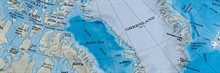
Expert opinion: critical raw materials in Greenland
Geopolitical developments are leading to increased attention for critical raw materials. To what extent do geological conditions determine these developments? In this section, specialists from the Netherlands Materials Observatory (NMO) explain how local geology plays a role and why this is important.
In this interview, NMO-expert Andor Lips explains the geological context of Greenland and answers questions about critical raw materials and their significance.
What makes Greenland a special region from a geological perspective?
“The island has a varied geology that bears many similarities to Canada and Scandinavia. This means that the chances of finding different types of ore deposits are reasonably high.”
"Over the past fifty years raw materials have been found at more than twenty locations. However, a large part of Greenland is covered by a thick layer of ice. What exactly lies hidden there is largely unknown. The potential is attractive, but Greenland is not unique in this respect. Countries with abundant raw material resources, such as Canada, Chile, Peru, Australia, Zambia and Kazakhstan, have already developed their geological potential much further into actual mining operations."
“The Arctic climate, remote location and lack of infrastructure make exploration and mining in Greenland exceptionally costly and time-consuming. Moreover, the ecological impact in the vulnerable polar region is particularly significant. As a result, several projects that were almost ready for exploitation have been postponed or halted.”
What critical raw materials are we talking about and what does ‘critical’ mean?
“At the moment, mining in Greenland is limited: some gold, anorthosite and rubies. These are not among the critical raw materials as defined by the European Union. However, there are known deposits of rare earth metals, titanium, germanium, lithium and platinum, in addition to base metals such as zinc and iron ore.”
“Critical refers to raw materials whose availability is under pressure, while demand is increasing. This is because these materials are often produced in only a small number of countries, while they are essential for the energy transition, digitalization and military applications. This concentration makes the chain vulnerable. It is therefore important to develop alternative sources - ideally closer to home - to use materials more intelligently, to increase recycling and, where possible, to replace materials with less scarce alternatives."
What is the difference between the presence of raw materials and the possibility of extracting them?
"The presence of a raw material does not automatically mean that it can be extracted profitably. There must be sufficient concentrations and feasible investment and infrastructure opportunities. In Greenland, the conditions are far from ideal: extreme cold, high transport costs and a lack of facilities make extraction difficult and expensive. In addition, the fragile ecosystem requires extra measures to prevent environmental damage, which further increases costs."
“In short, Greenland's geological potential is interesting. At the same time, factors such as its location, climate and limited infrastructure mean that the development of raw materials there remains challenging.”